Tuesday, December 24, 2013

The Santa Claus Years

I was a fervent believer in Santa Claus. When I was seven or eight years old, growing up in Chatham, N.B., a kid at the White School told me that there was no Santa, that the stories about him were all lies and the presents he supposedly left were all bought by my parents. I scoffed at her. Scoffed! She might as well have told me there were no stars in the sky.

I saw plenty of Santas when I was a little girl: we used to go to the old Opera House on Wellington St. in Chatham for a visit with Santa. We sat on his knee and told him what we wanted for Christmas. He said, "Ho ho ho," and gave us a small paper bag of hard candy. This happened again at the Sunday School Christmas concert in the United Church hall and at other public events around the town.

I was never fooled for one minute nor was I bothered by these little ceremonies. I was as polite as I could be, saying, "Hello, Santa," and listing off my heart's Christmas desires. I always thanked him and walked away.

Never once though did I believe that any of these fellows was really Santa. I didn't even believe that they were -- as some people posited -- some kind of official "helper." I knew they were just guys from around town, playing the part of Santa, and that was fine with me. I didn't give them a second thought. I only believed in the real Santa.

Many of my ideas and impressions of Christmas came from a book that came out every year at the same time as the decorations and the special candles. It may have looked like this:

although by the time I was able to remember it, the hard covers were gone and it was a little ragged around the edges. The book had poems, carols, drawings and stories at least two of which were almost unbearably sad: The Little Match Girl and The Happy Prince.

There were things in the book I didn't really understand but they created a Christmas image

that stays with me to this day. Many years later, my husband found a similar book which now comes out every Christmas in our household. It has all the old favourites and reading The Happy Prince can still bring tears to my eyes.

In those days, little girls wore long brown ribbed stockings. They were held up by garters that were attached to an undergarment called a waist.

The stockings went all the way up and they had some "give" so they could easily accommodate lots of goodies and these were the stockings we hung on Christmas Eve. We hung them in the archway between the living room and the dining room and after the ritual of choosing a selection of cookies and fruitcake and making a cup of tea for Santa, off we went.

The magic of Christmas morning has never changed for me. When we crept down the stairs and peeked around the corner, the first thing we saw was fresh snow that had been tracked across the living room carpet. That was our first clue that he had been there. A few more steps and we could see the lovely array of presents and the fat bulging stockings. Our father would have stoked the furnace, our mother would have started the Christmas music -- and those stockings beckoned.

The stockings always included small toys and books, maybe a hairbrush and comb and barrettes, maybe some perfumed bath powder. I mostly remember the wax paper packages of fruit and candy though. Of course, the legendary orange was always in the toe. But at regular intervals throughout the stocking, there would be bunches of grapes, a banana, an apple -- always a Red Delicious called, in our house, a Christmas apple or more often, a Santa Claus apple.

There were also wrapped packages of hard candies and of peppermint-cream-filled chocolates. There were those once-a-year specialty sweets: barley toys and ribbon candy.

And -- as sure as Christmas had arrived -- there were Ganong's chicken bones. They were as much a part of Christmas as the turkey and the tree and they still are at our house.

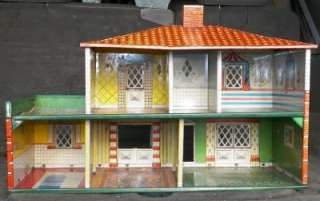
I remember some of the big presents over a number of years -- the toboggan, the sled, the skates, all the dolls. I have a special memory of the dollhouse. How I loved sitting at its back open wall, spending hours moving the family members and their furniture around from room to room, imagining interesting lives and activities for all of them. This was in the days before everything was made of plastic and my dollhouse was made of tin. It was simple but wonderful.
But as we're so fond of reminding one another -- and especially reminding the children -- it's not the gifts we remember, it's the magic. The magic for me was all about Santa Claus. I know there's some controversy these days about whether it's good to deceive your children by letting them believe in Santa. I don't think anyone could have stopped me from believing in Santa so it was never an issue for me.

I believe in him still. Nowadays, when I creep down the stairs on Christmas morning and see the fat, bulging stockings, the old magic returns and I feel the same way that I did all those years ago. It's even more interesting and magical when you consider that I filled those stockings myself, before I went to bed.

Have a happy and blessed Christmas and a wonderful 2014.

Tuesday, December 25, 2012

Back by popular demand

Christmas on the Ocean Limited

(This piece was written and published a number of years ago. When the late Peter Gzowski was hosting Morningside on CBC Radio, he asked listeners to send him something about Christmas for his Christmas Eve program. I sent this and he read it to end his program that day. Years later, I read it myself on Christmas Eve, on the CBC Radio Mainstreet program that covered the Maritimes. I have been asked to share this story again so here it is. It's my own personal Christmas tradition! I hope you enjoy it and I wish you all the best of the Christmas season.

Here's the story.

Sunday, October 21, 2012

One winter day in Halifax

One of the "life stories" that has made the most difference to my life didn't happen as I was growing up. It was many years later, on a winter's day in downtown Halifax, that the events took place that would leave my life changed forever.

This story has been published before so this could be considered a later edition.

This is how the story starts:


On January 9, 1989, I walked home for lunch in downtown Halifax. It was unusual for me to go home for lunch. I was a magazine editor and there were always lots of people (writers!) who wanted to have lunch with me. I sometimes wonder what life would have been like if I had eaten out that day.

I unlocked the front door, went in and tossed my coat on the couch. I was immediately struck by the fact that I was not greeted by three cats. They had their own door/tunnel leading from the first floor bathroom window out to the deck but none of them liked the cold — and it was a cold day.

I went into the dining room and saw the doors to the china cabinet were standing open and my mother’s silver flatwear had been placed in my own suitcase, which was open on the floor.

While I stood trying to register what this meant, I heard someone coming down the stairs. I knew immediately that there was a burglar in the house. I stood still — there was nowhere I could go. I had always heard that people who did break-and-enters didn’t want to confront anyone and I imagined that he would rush down the stairs and straight out the front door, happy to be out of there.

But he came around the corner to where I was standing and he had a knife in his hand. He laid the knife against the side of my face and said, “Don’t try anything and you won’t get hurt.”


The story is written in five parts and here they are, all linked up for your reading convenience.

Part One

Part Two

Part Three

Part Four

Part Five

Monday, August 20, 2012

On the beaches, on the wharves, in the gravel pit. . .

From the time I moved to Chatham at the age of five until my early teens, I lived in a house that was part of a group called the "hydro houses" – although the power supply at the nearby plant didn't come from water. I guess they should have been called the "NB Power" houses – my father worked at the plant – but for the sake of simplicity, I'll stick with the hydro houses.

There were six houses, three on either side of a small street. There were three styles of house and each one faced its mirror image. They were at the very edge of Chatham, on the road to Loggieville. That road is very built up with subdivisions now but then, our houses and the neighbours right behind were just about the last houses before you got to Forrest Corner which you reached just before Loggieville.

The "Welcome to Chatham" sign was in our backyard. As little kids, we thought it was fun – magical, almost – to jump back and forth on either side of the sign and do "now-we're-in-town, now-we're-not."

The neighbours behind us, on the other side of the "Welcome to Chatham" sign, were the Sprays. The elder Mr. Spray, who seemed very old to me at the time but probably wasn't, had gone to fight in the Boer War. His son, Charlie, was a carpenter and cabinet-maker. Sometimes, we were allowed to go over to Charlie's workshop and watch him while he worked. The smell of new wood, freshly cut, can still take me back to that workshop.

At the end of our side of the little street was a stand of quite large evergreens which we called "the woods." It was a lovely place to play – there was lots of walking room as the lowest branches were way higher than we were. One of the fathers had put up a swing and there was a little wooden building – left from the construction of our houses – that we called "the playhouse."

At the end of the other side of the street was a field, a field that stretched all the way to the Shore Road which ran alongside our beloved Miramichi River.

At the top of the field, we had laid out bases and stomped down enough of the grass that it served as our ballfield. We – the kids from the hydro houses – played ball with the MacFarlanes and the Thorburns from the Hollow and with other kids who often showed up from the Hill or from further uptown.

There was a path which led from our houses across the field, around the ballfield, over to a lane – more like a wagon track – that ran alongside Howard MacIntosh's field. It was used a couple of times a year, probably during haying although I wasn't keeping track. Our fathers used the path and the lane when they walked to work at the NB Power plant.

Near the bottom of the field, approaching the Shore Road, was a gravel pit. We spent many happy hours in the gravel pit – it seemed very big to me, and maybe it was. There was an "island" in the middle of the gravelly wasteland, an upward protuberance that was topped with grass and, I was told, was the last place the bulldozer/digger stood before the gravel pit was abandoned by heavy equipment. We used to scramble to the top of the island which wasn't easy as the central part had eroded away and it involved hanging almost upside down while trying to make it over the top.

On the days we were going swimming, we would pass right by the gravel pit and head down the Shore Road. We were usually on bicycles. The nearest beach was McIntyre's. It wasn't a great beach but it was the nearest and that was its appeal. Further along was The Grove, a nicer beach but frequented by older teenagers and we were often made to feel unwelcome there. (Our impression was that there were shenanigans going on.)

The last beach downriver along the Shore Road was Terrill's Point and we usually didn't go there on bikes but one of the fathers would often drive us down after work.

The real treat for an after-work swim though – or for a Saturday or Sunday afternoon – was a trip down past Loggieville to Manderson's Beach. Manderson's was sandy – it was tidal so it could also be sea-weedy – and it had a canteen for hot dogs and ice cream and other treats. There were a few cottages just to the left after driving down the dirt road and I always envied the people who were there all the time, living at the beach.

(This is not Manderson's but it's just a bit down-river and it looks similar.)

I loved swimming in the Miramichi – it couldn't have been very clean because there were polluting industries upriver, not to mention no sewage treatment – and I never liked swimming in fresh-water lakes. I found lake water cold.

I think the Miramichi would be much cleaner today.

I had another swim in the Miramichi one day that was more inadvertent than my swims at Manderson's.

I was hanging out with other kids at the cement plant wharf. The cement plant was on the extreme opposite end of Chatham from where I lived – at the edge of town on the road to Newcastle. There were ships there occasionally.

I don't remember a lot of the details about this particular day or even who all was there. There were a few kids – we had biked there – and we were all probably around 12 or 13. We were sitting around, talking about this and that. At some point, we got up – were we making plans to leave? – and one of the boys picked me up and, without warning, threw me into the river.

I could swim but I was taken terribly by surprise and I still remember the frightening sensation of sinking, deeper and deeper. I struggled to change direction and finally broke the surface, gasping and sputtering. I wasn't having an easy time of it. I was fully dressed, remember.

Just then, a boy named Billy MacLean (whom I didn't really know) jumped in beside me. He put his arms around me and "swam me" a few metres downstream until I could touch bottom and walk to shore. I have no further memory of what happened next. I guess I got on my bike and went home.

A few years later, Billy MacLean sustained a serious head injury when he ran headfirst into the boards during a hockey game. I was told that his personality was dramatically changed by the accident.

Thursday, August 2, 2012

'Is this the party to whom I am speaking?' *

My son is 17. As with most of his contemporaries, his phone appears to be permanently attached to his body. He holds text conversations, often with up to five or six people simultaneously while keeping an eye on the NBA draft, reporting bits and pieces of news items that pop up, updating Facebook, following Twitter, playing a game, watching YouTube. He lives a lot of his life inside that phone.

(I have written about the world and the language of text, right here, if you're interested.)

I don't usually play the "when-I-was-your-age" game. I try to avoid anything that resembles old-fogey-ism. I did tell him about the telephone though.

In the house where I grew up, when you came in the front door, you were in the hall. If you bore right, you would go upstairs – the stairs were open to the hall but separated from the downstairs by a wall. If you went straight ahead, you were in the heart of the house, with the living room to the left and the kitchen straight ahead.

The door from the hall and the door into the kitchen both opened into the living room area (it wasn't really separate from the living room; it was an outcropping of the living room) and were pinned back against the wall by a small piece of furniture called a "telephone bench" – or, I've since learned, also called a "gossip bench."

Ours was green, vinyl-covered, with two shelves on one side and a seat that raised to allow for storage underneath.

This is one:

And here's another:

Neither one of these is really like ours but if you combine certain elements from each, it would be sort of like ours.

Inside the storage seat were old catalogues and magazines and, for some reason, this toy:

I have no idea why I remember this, or why those things were kept there. I have no memory of anyone ever playing with them although I can still remember exactly how it felt to squeeze them and see the ping pong ball fly out. And yes, you were supposed to catch it.

Finally, this is what the telephone looked like – with the exception of the coiled cord:

Our number was 456-12 – expressed as four five six ring twelve. When it was for us, it rang one long, two short. All our phone conversations – intimate ones with boyfriends, secretive ones with girlfriends – were held just steps away from where family members were reading the paper, listening to the radio, chatting among themselves. Sometimes, if I felt I really needed the privacy, I would haul the little gossip bench out, squeeze myself behind one of the doors and try to have a jacket or something to build a little tent over my head. The vacuum cleaner was behind there too.

When we had this kind of phone, it was a party line. It didn't seem any kind of inconvenience as it had always been this way and we became used to sharing the line with neighbours. It was another level of learning to speak somewhat guardedly – maybe leading to a reticence which is not so obvious in subsequent generations!

"Listening in" was not routine at our house but we knew houses where it was. We knew one woman who kept an oven mitt beside her phone to cover the receiver when she wanted to listen in to a conversation on her party line.

Do you remember this?

When one of my friends got one – the Princess Phone – for her bedroom, we were all a little jealous. I never did get a Princess Phone. (Later on, the teen generation that was after me but before cell-phones, often had not only a phone in their bedrooms but their own phone line. They were listed in the phone book under the family name as, "teenager's phone.")

Today, our landline supports our primary cordless phone downstairs, as well as a hands-free phone (with head-set) and a fax phone. There are phones in two of the bedrooms upstairs.

Among the three of us, we have an iPhone, a Blackberry and a simple little Samsung with a sliding full keyboard (mine). I got my phone after I was struck by how few public pay phones are left in the world. (My cell phone number begins 456 – the same four five six as the first phone I remember.)

I don't intend this to be nostalgic although telephones are occasionally more ubiquitous than I would wish. I still know people who don't carry phones everywhere they go and they survive. I often get annoyed at people who have loud phone conversations in public places. And I could happily get along without the endless telemarketing even though I have gone to the trouble of getting on the no-call lists. They don't work as well as I'd like.

The telephone has been used a great source of humour, however. From Shelley Berman to Bob Newhart to the great Lily Tomlin. . .

* Here's Ernestine, telephone operator, chatting with the incomparable Cher.

Wednesday, July 18, 2012

Sure, I wish I'd practiced more . . .

I took music lessons – piano – for several years, beginning when I was quite young, probably seven or eight years old.

My music lessons were given in St. Andrew's Hall which was attached to the United Church at the back and which fronted on Henderson St. in Chatham. You can see a bit of it on the far right in this picture:

Just inside the door were the minister's office and the choir room where the gowns were kept and where members of the choir gathered before each service.

The hall itself was used as a meeting place for youth groups and as a gym – non-regulation size – and kids played basketball, volleyball and badminton there.

On the right-hand side of the hall was an open stairway that led up to a balcony/mezzanine. I remember that whole area – which was in two sections – being used as a storage area for extra chairs and boxes of books.

Through another door at the back of this balcony was a long narrow room with two pianos. This is where the half-hour once-a-week music lessons happened.

In looking back, I can't imagine children today being sent up those stairs into a closed room to spend half an hour alone with the music teacher.

Each of the music teachers – besides doing the private lessons – was organist and choir director at the United Church and also taught music at Chatham Grammar School.

My teachers were, in this order: Pauline Whitman, Jack Armstrong, Vera Zwicker and Professor Moir (who was the younger brother of the legendary Irene Moir, award-winning choir director and voice teacher at St. Michael's Academy.) I think I may be missing a teacher, a less serious, more frivolous young woman who didn't meet with the approval of the ladies of the United Church choir. Or maybe I'm imagining her.

I liked the teachers. Miss Whitman was sweet and appealing. She was very much respected as a musician and the choir ladies loved her. It was hard to take Mr. Armstrong as seriously because he was relaxed and laid-back and didn't seem to take himself very seriously. I'm pretty sure he was also an accomplished musician.

Miss Zwicker was eccentric. She was not comfortable in her own skin and although I don't think anyone ever doubted her musical abilities, she was not as much appreciated as teacher/director because it was hard to feel comfortable with her.

Professor Moir, as far as I know, was taken seriously by everyone, himself included. I remember him as kind of a fussy fellow, almost a caricature of a music teacher. I may be wrong though. I was pretty young.

There was one more teacher. One year – I'm not sure why – I was sent up to St. Michael's Academy, then a Catholic school.

The door nearest to downtown led me into a front hall that passed the auditorium on the left and offices on the right. Straight ahead was another door that led into a long corridor with windows looking into the auditorium on one side and a series of small music rooms – furnished with pianos and other instruments – on the other side.

It was in one of those small rooms where I met Sister Dionne, hands properly out of sight, tucked into the wide sleeves of the full habit of the school's founders, the Religious Hospitallers of St. Joseph. Looking a little like this:

I was a little afraid of Sister Dionne although she was very kind to me. She was a very accomplished musician – she played the piano for me a couple of times – and she could be five feet away with her back to me and "hear" that I was using the wrong fingering for my pieces. If she was near me and my fingering was wrong, she cracked her slender little hard-wood pointer across my knuckles which, I have to say, hurt like hell.

She held my face in her hands and called me her Rose of Sharon. I expect she prayed for me to become Catholic but that was still many years in the future.

I have fairly neutral memories about my music lessons. They didn't make me particularly happy – or unhappy. Like most children, I didn't enjoy practicing and I thought there was entirely too much emphasis placed on scales. I liked some of the work that was more like school-work. I remember a project which involved cutting out information and pictures and putting together little bound booklets on several of the great composers – the story of their lives and families, and how their lives in music developed: Mozart, Beethoven, Tchaikovsky and others. It was a very enjoyable project.

I didn't enjoy the little pieces I had to play over and over. I envied those people who could play "by ear" and I entertained fantasies of playing sing-able songs and being the life of the party. I loved the Mammoth Book and I played some of the songs from it.

I remember playing Aura Lee -- which I was delighted to discover was the same tune as the Elvis Presley hit, Love Me TenderSilver Threads Among the Gold, Beautiful Dreamer, Down by the Old Mill Stream, When You and I Were Young, Maggie.

I loved music from olden times. I still do.

The focus of all those music lessons was preparing for the annual Miramichi Music Festival. It went on for several days with events held at different schools in both Chatham and Newcastle. Some years, depending on how my birthday related to the festival's dates, I played in more than one age category. For example, when I was nine, I played in both the 10-and-under and the 12-and-under. Most years, I played one or two solo numbers and a duet. I usually played duets with Betty Cameron and at least once, I played with Dawn Williston.

The pianists and vocalists always knew one thing: if we were in the same age category as Doreen Bryenton from Newcastle, we were pretty much aiming for second place, having conceded top spot to her. She was an excellent musician; fortunately, she was a little older than I so I wasn't always up against her in competition. I think maybe I did come out ahead of her one year although I can't remember the details now.

One thing I do remember is that if our competition was in Newcastle, we would be taken there early in the day and have to sit through several other categories, listening to innumerable singers, all singing the same song, of course. To this day, I can hear Who is Sylvia? being sung in my head in many different voices. This one is Dame Janet Baker and I must say, it's lovely.

If you won your category, you got to perform at the Final Concert. One year, when Betty and I won the duet category, the concert was recorded by the local radio station and someone there made each performance into a 78 rpm vinyl record. Yes, I still have it.

While I was growing up, our family had a big upright piano. When we moved to a smaller house, my mother got rid of it and bought a much smaller one – what she always called an "apartment-sized piano." It has one less octave than a regular piano – four keys missing on either end of the keyboard.

The little piano is mine now and many years later, I was living in Ottawa and had a piano tuner come in to take care of it. He was a taciturn fellow but he played it nicely when he was finished – it sounded lovely – and I said, "It's a nice little piano, isn't it?"

"This is not a piano," he muttered. "This is a spinnet."

Well, fancy that. A spinnet.

You learn something new every day.